August 1, 2026
Why Do Cats Knead? Meaning, Claws & When to Worry
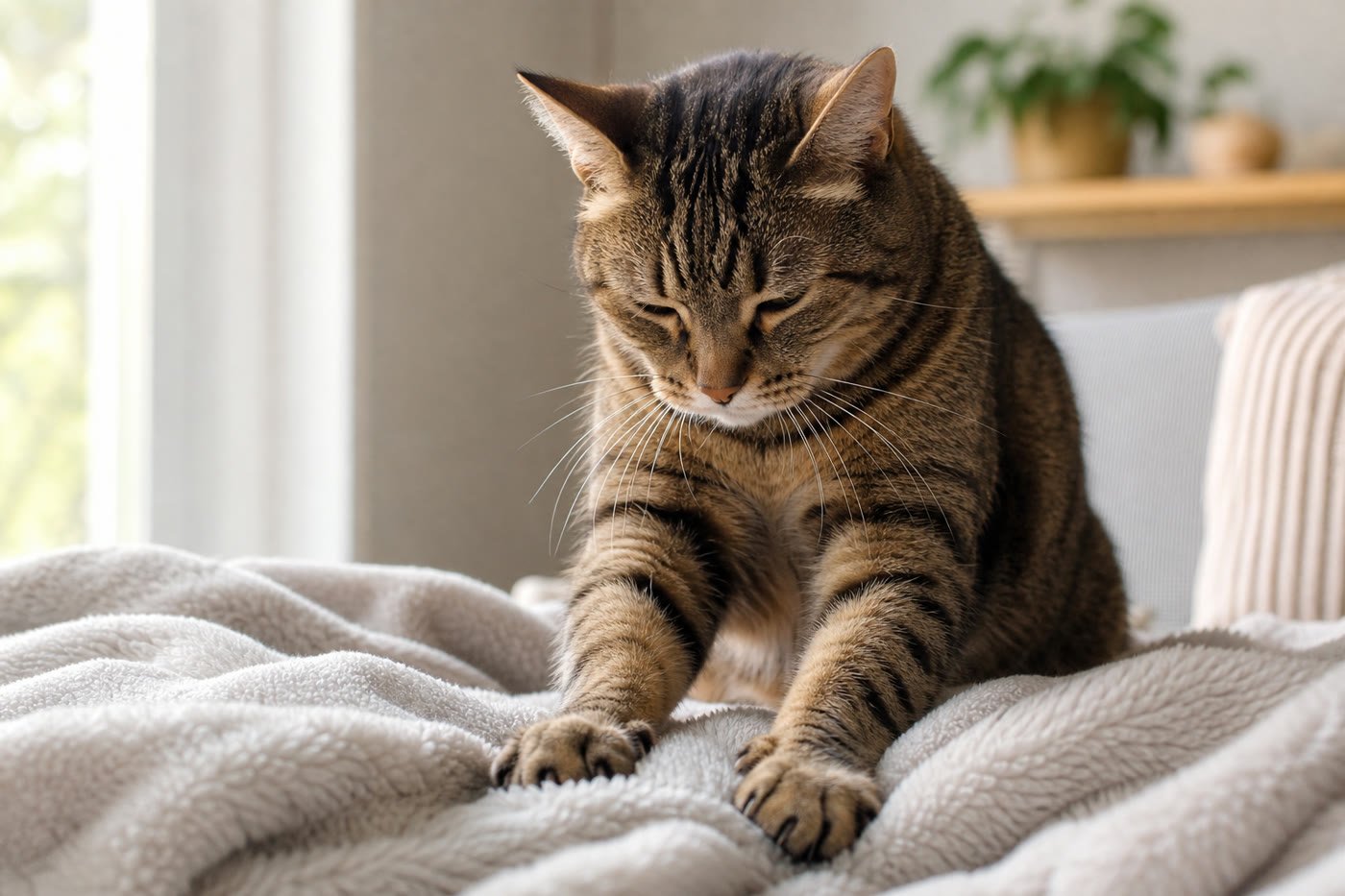
When a cat rhythmically presses one front paw and then the other into a blanket, bed or person, the behaviour is called kneading. It begins in kittenhood and often continues throughout adult life. Most kneading is normal and appears in comfortable, familiar situations.
This guide answers why cats knead, explains related behaviours such as purring and drooling, and shows how to protect skin and fabrics without discouraging the cat.
Why do cats knead blankets and people?
Kittens knead around the mother’s mammary glands while nursing. Adult cats may retain the movement as a comfort behaviour and use it when settling, resting or interacting with a trusted person. Cats may also leave scent from glands around the paws. The exact reason in any one moment cannot be proved from kneading alone.
The kittenhood origin
Kneading helps newborn kittens stimulate milk flow while nursing. Cats Protection explains that adult kneading is thought to be linked with comfort, although the precise reason the juvenile behaviour persists is not fully known. It is seen in cats with many different weaning histories and is not, by itself, evidence that a cat was separated from the mother too early.
Five likely functions in adult cats
- Settling: the repetitive motion may form part of a familiar relaxation routine.
- Social comfort: a cat may knead while resting beside a trusted person.
- Preparing a surface: pressing and turning can precede lying down.
- Scent communication: paw-area scent glands may contribute to marking a familiar resting location.
- Stretching: alternating the paws extends toes, wrists, shoulders and back.
These explanations can overlap. Avoid translating kneading into one human emotion with certainty; interpret the cat’s entire posture and the situation.
What relaxed kneading looks like
- Soft eyes or slow blinking
- Neutral ears rather than flattened ears
- Loose facial muscles and whiskers
- Choosing to approach and remaining free to leave
- Settling into rest afterwards
- Purring in a calm context
Purring can accompany contentment, but cats may also purr under stress or discomfort. Kneading plus tense posture, hiding, appetite change or touch sensitivity deserves closer attention.
Why does my cat knead me?
Your lap may be warm, soft, familiar and associated with safety. The behaviour does not establish ownership and is not dominance. Treat it as voluntary interaction: let the cat approach, avoid holding it in place and stop contact if body language changes.
Why do claws come out?
Toe extension is part of the movement, so claws may emerge even when the cat has no intention of scratching. Place a thick folded blanket between paws and skin before the cat settles. Move slowly rather than lifting or pushing suddenly, which can startle the cat.
How to manage painful kneading
- Keep a dedicated thick blanket beside the preferred sitting area.
- Invite the cat onto the protected surface before kneading begins.
- Reward settling there with calm attention.
- Keep claws maintained using cooperative handling or professional help.
- If pressure becomes painful, stand slowly or slide the blanket away rather than punishing.
Never declaw a cat to solve kneading. Declawing removes part of each toe and creates serious welfare concerns.
Kneading, suckling and drooling
Some cats suck or mouth a blanket while kneading; others drool when deeply relaxed. Occasional behaviour without fabric ingestion or health change may be benign. Veterinary advice is warranted when a cat chews or swallows fibres, damages the mouth, develops excessive new drooling, loses weight or cannot disengage from the activity.
When kneading changes suddenly
A new increase can follow environmental change or a greater need for comfort. A sudden decrease may reflect pain in paws, joints or the back. Inspect for limping, swelling, broken claws, reluctance to jump, sensitivity and altered grooming, then consult a veterinarian rather than relying on an online explanation.
Do all cats knead?
No. Some knead frequently, some make small paw movements and some rarely do it where people can see. Frequency varies among individuals and can change with age, surface and routine. Not kneading does not mean a cat is unhappy or lacks attachment.
Related feline signals
| Signal | Possible context | What to observe |
|---|---|---|
| Slow blink | Low arousal or social comfort | Loose posture and voluntary proximity |
| Purring | Comfort, solicitation or coping | Health and complete body language |
| Tail lashing | Rising arousal or conflict | Stop touch and allow distance |
| Head rubbing | Social and scent communication | Whether the cat initiates contact |
For a broader interpretation of tension and environmental pressure, read our guide to signs of stress in cats.
Frequently asked questions
Why does my cat knead before sleeping?
It may be part of a learned settling routine associated with a comfortable surface.
Does kneading mean my cat loves me?
It often occurs in a secure social context, but one behaviour cannot prove a specific human emotion.
Why does my cat knead my stomach?
It is warm and soft. Use a thick blanket if the pressure or claws are uncomfortable.
Why does my cat bite the blanket while kneading?
Some cats combine suckling or fabric holding with kneading. Prevent fibre ingestion and seek veterinary advice if it is compulsive or destructive.
Should I stop my cat kneading?
Usually no. Redirect to a durable blanket and manage claws unless the behaviour creates injury or involves ingestion.
Is excessive kneading a sign of anxiety?
Frequency alone is not diagnostic. Consider recent change, posture, health and other behaviour, and consult a veterinarian when concerned.
Kneading is usually normal. Sudden change, pain, excessive drooling or fabric ingestion should be discussed with a veterinarian.