August 1, 2026
How to Crate Train a Puppy: A Gentle Step-by-Step Guide
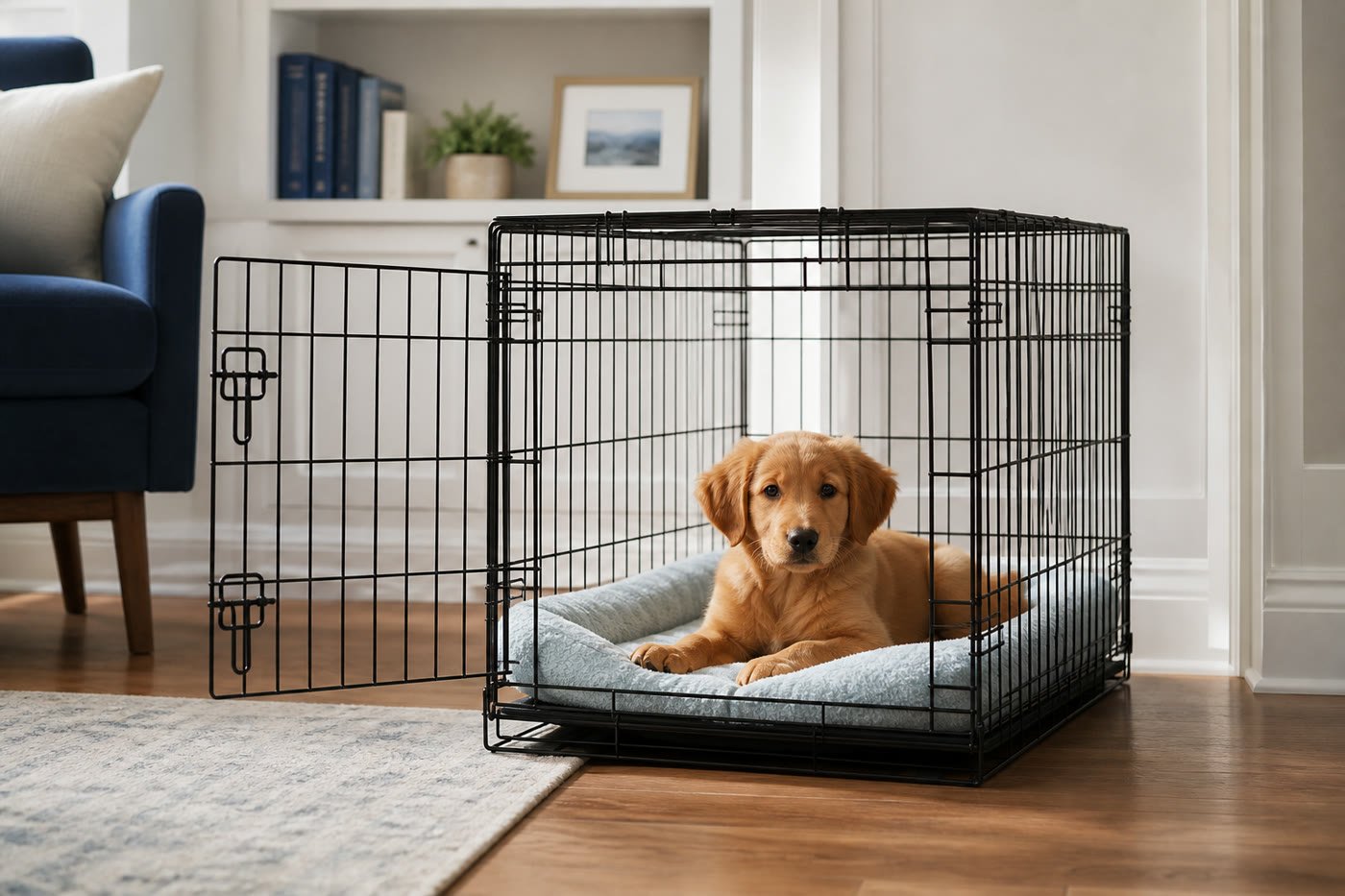
A crate can become a quiet resting place, a travel skill and a useful part of short-term management. It should never be a punishment or a place where a puppy spends most of the day. Successful training is voluntary, gradual and matched to the individual puppy.
This complete guide explains how to crate train a puppy, from choosing the right setup to closing the door, leaving the room and handling night-time safely.
What is the fastest safe way to crate train a puppy?
Place the crate in a calm social area, secure the door open and let the puppy explore. Feed treats and meals inside, then close the door for only a few seconds while the puppy remains relaxed. Increase duration and distance separately. Return before distress and use toilet breaks, exercise and rest to set the puppy up for success.
Choose and prepare the crate
- It should allow the puppy to stand, turn, stretch and lie comfortably.
- A divider can resize a larger adult crate during growth.
- Remove collars or harnesses when snagging is a risk and the puppy is safely contained.
- Use comfortable, washable bedding only if the puppy does not shred or swallow it.
- Keep the crate away from intense heat, draughts and direct sun.
- Place it near everyday life without putting it in the busiest walkway.
Blue Cross advises introducing a crate as a safe place, keeping the initial door open and building up the time gradually rather than using it for punishment.
Stage 1: make entering voluntary
- Secure the door so it cannot swing and startle the puppy.
- Scatter food just outside, then at the entrance and progressively farther inside.
- Allow the puppy to leave immediately; do not push or block the exit.
- Serve meals near the entrance, moving the bowl inward over several sessions.
- Add a verbal cue only after the puppy is entering reliably.
Do several repetitions and stop while the puppy still wants more. A puppy choosing to nap inside is useful progress, but it does not yet mean the puppy is ready to be locked in alone.
Stage 2: close the door briefly
Give a safe activity or part of a meal inside. Close the door for one or two seconds, reopen it before concern appears and let the puppy decide whether to exit. Build from seconds to minutes over multiple sessions. Stay beside the crate at first and vary duration so every repetition is not harder than the last.
Stage 3: add distance
Once the puppy can relax with the door closed, stand up, sit down, take one step away and return. Increase distance before adding long duration, then practise briefly leaving sight. Coming and going should be uneventful. A camera can reveal whether the puppy settles or becomes increasingly distressed when nobody is present.
Crate training at night
Young puppies may need overnight toilet breaks. Place the crate close enough to hear restlessness, take the puppy quietly to the toilet area and return without starting a play session. Do not expect a very young puppy to remain clean for an adult dog’s schedule. Veterinary advice should guide concerns about unusually frequent urination, diarrhoea or discomfort.
Whining: wait or respond?
First consider toilet needs, temperature, pain, fear and whether the training step was too difficult. Brief mild protest may stop when the puppy settles, but escalating barking, panting, drooling, frantic scratching or refusal of food signals distress. Open calmly when safe, reduce the next step and seek professional guidance for persistent separation-related behaviour.
How long can a puppy stay in a crate?
There is no universal number. Age, bladder control, sleep, health, previous training and whether the puppy is awake all matter. A crate is not a substitute for toileting, movement, social contact, training and exploration. Plan care around the puppy rather than stretching confinement to fit a schedule. Read our guide to how long a dog can be left alone for the wider welfare context.
A seven-day starter plan
| Days | Primary goal | Success looks like |
|---|---|---|
| 1–2 | Voluntary entry | Puppy enters and exits comfortably |
| 3–4 | Door movement | Door closes for seconds without tension |
| 5–6 | Short duration | Puppy eats or rests while you sit nearby |
| 7+ | Small distance changes | You move briefly and return before concern |
This is not a deadline. Repeat an easier stage whenever body language changes. Some puppies need days; others need weeks.
Common mistakes
- Putting the puppy inside only when everyone leaves
- Increasing time, distance and distractions simultaneously
- Letting children enter or disturb the crate
- Using confinement after scolding
- Ignoring escalating distress
- Leaving unsafe chews or bedding unsupervised
- Using the crate to compensate for insufficient care
Alternatives and complements
A secure pen, gated room or puppy-proofed area may offer more movement for longer management periods. The best arrangement can combine an open crate for rest with a larger protected area. Individual dogs also differ; a crate is useful only when the dog can genuinely feel safe in it.
Frequently asked questions
Should I cover the crate?
A partial cover helps some puppies and worries others. Maintain ventilation, prevent fabric from being pulled inside and observe the puppy’s response.
Should food and water go inside?
Meals can build a positive association. Water access depends on duration, temperature and veterinary needs; never restrict necessary water to avoid toilet breaks.
Can two puppies share one crate?
Each dog should have an appropriately sized individual safe space. Sharing can create crowding, conflict and safety risks.
Why will my puppy enter but panic when the door closes?
Entering and confinement are separate skills. Return to tiny door movements and reopen before tension.
Can crate training fix separation anxiety?
No. Confinement can worsen panic. Suspected separation anxiety needs an individual veterinary and behaviour plan.
When should I stop using a crate?
Use it only while it remains helpful, comfortable and appropriate. Gradually expand freedom when toileting, chewing and settling skills permit.
Never leave a puppy to panic in a crate. Persistent distress requires veterinary and qualified behavioural support.