July 31, 2026
Do Cats Like Tunnels? Play, Placement & Safety Guide
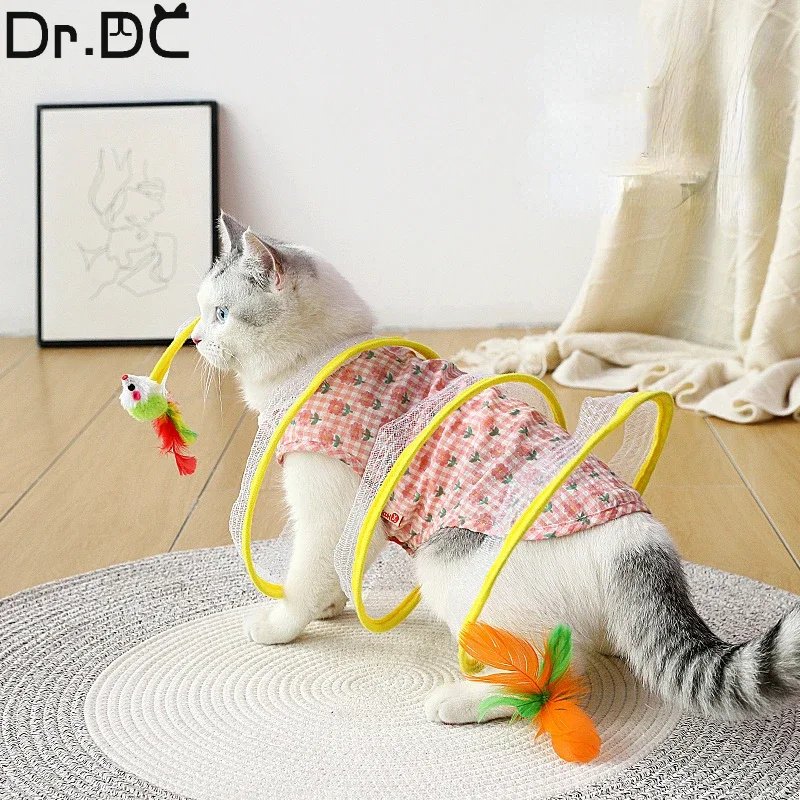
Many cats enjoy tunnels because they combine hiding, watching, chasing and sudden pouncing in one simple object. Others ignore them until the position, stability or play style changes. The useful question is not whether every cat likes tunnels, but how to offer one safely and let the cat choose.
This guide answers do cats like tunnels, explains placement and play, covers kittens and multi-cat homes and shows what to inspect in a collapsible tunnel.
Cat tunnels: quick answer
- Many cats enjoy enclosed routes for hiding and ambush play.
- Place the tunnel where both exits remain open.
- Let the cat investigate without being pushed inside.
- Use interactive toys outside the tunnel, never fingers inside it.
- Supervise attached feathers, mice, strings and elastic pieces.
- Inspect the fabric and internal spring frame before every session.
Why do cats like tunnels?
Tunnels support several normal behaviours: hiding, stalking, chasing and observing from partial cover. Cats Protection recommends play that allows cats to stalk, pounce, chase and bat safely, and notes that cats often enjoy climbing and hiding.
A tunnel also changes how a familiar room feels. It creates a temporary route and ambush point without requiring permanent furniture. Preference still varies with age, confidence, mobility and past experience.
How to introduce a cat tunnel
- Open it fully and confirm the frame is stable.
- Place it in a quiet, familiar room with both ends clear.
- Allow the cat to approach and smell it independently.
- Put a favourite toy near one entrance rather than forcing the cat inside.
- Roll a toy through or move a wand past the opposite exit.
- End the session before play becomes overexcited.
Best place to put a cat tunnel
Try it beside furniture, along a normal walking route or near—but not blocking—a preferred play area. Leave enough space around both ends for the cat to enter and exit freely. Avoid stairs, doorways, heaters, open flames and places where people may step on it.
Some cats prefer a tunnel against a wall because it feels less exposed. Others engage more when it points toward a window or cat tree. Rotate position occasionally, but do not constantly move it if the cat uses it as a predictable resting place.
Seven safe games to play with a tunnel
- Roll-through: send a lightweight ball through the tunnel.
- Pass-by prey: move a wand toy across one exit.
- Peek and pause: let the toy appear briefly and disappear.
- Paper chase: slide a safe paper ball past the outside edge.
- Treat trail: place a few measured treats near and then just inside.
- Two-tunnel route: use separate tunnels with space between for confident cats.
- Quiet hide: leave the tunnel available with no demand to play.
Do not put hands or feet into the tunnel during active play. A hidden cat may pounce with claws or teeth as part of normal hunting behaviour.
Are cat tunnels safe for kittens?
A kitten can use an appropriately sized tunnel under close supervision. Check that openings are large enough, the structure cannot collapse around the kitten and there are no loose pieces to chew or swallow. Remove attached toys if they begin to fray.
Can multiple cats use one tunnel?
Some compatible cats chase through a tunnel together, while others may guard an exit or trap a less confident cat. Provide more than one route and never position the only exit against a wall. Watch for staring, blocking, flattened ears, growling or one cat avoiding the area.
Resources should be spread throughout a multi-cat home. One tunnel cannot replace separate beds, hiding places, litter trays, food and water locations.
Cat tunnel safety checklist
- Keep every entrance and side opening unobstructed.
- Check the spring-wire frame remains fully covered.
- Remove the tunnel if wire protrudes or fabric tears.
- Supervise mice, feathers, balls, strings and elastic attachments.
- Choose openings suitable for the cat’s body size.
- Keep it away from stairs and busy walking paths.
- Collapse and store it only when no cat is inside.
- Follow the exact cleaning and assembly instructions.
Why is my cat hiding in the tunnel?
Resting or waiting to pounce can be normal. Cats Protection explains that cats may hide to sleep, feel safe or wait for play. A sudden increase in hiding, especially with reduced appetite, toileting changes, pain or low energy, can indicate stress or illness and should be discussed with a veterinarian.
How to clean a cat tunnel
- Remove loose fur with a lint roller or suitable vacuum attachment.
- Detach toys only as permitted by the instructions.
- Spot-clean or wash according to the fabric-care label.
- Rinse away cleaning residue.
- Dry fully while open to prevent damp folds.
- Inspect seams and wire channels before returning it.
Tunnel vs box vs cat cave
| Option | Primary use | Key difference |
|---|---|---|
| Cat tunnel | Active play and passing through | Usually has two open ends |
| Cardboard box | Hiding, play and exploration | Easy to replace and customise safely |
| Cat cave bed | Rest and enclosed sleep | More stable and padded |
| Cat tree | Climbing, scratching and height | Permanent vertical structure |
For resting-focused choices, see our guide on whether cats like enclosed beds.
Frequently asked questions
Why does my cat run through the tunnel at night?
Cats often have bursts of activity around dawn and dusk. Schedule interactive play earlier in the evening and keep the tunnel away from sleeping areas if noise is disruptive.
Can a cat sleep inside a tunnel?
Yes, if the tunnel remains stable, ventilated and unobstructed. Never collapse, move or store it without checking inside.
Why does my cat ignore a new tunnel?
It may smell unfamiliar, move too much or sit in an exposed location. Give it time, move it beside a wall and use familiar play nearby.
Are attached feather toys safe?
Only under supervision. Remove any frayed, loose or damaged attachment and prevent swallowing of feathers, string, elastic or small parts.
How many tunnels do multiple cats need?
There is no fixed number, but provide enough separate routes and hiding choices that no cat can control access to the only tunnel.
Create a safe tunnel route
Place the tunnel where the cat can enter and leave from more than one direction. Stabilise it on a non-slip surface and inspect the fabric, wire covering and attached toys before every session. Rotate its position occasionally, but retain familiar hiding places so play does not remove the cat’s sense of security.
This guide provides general play and enrichment information. Contact a veterinarian about sudden hiding, pain or behavioural change.