July 31, 2026
How Long Can a Dog Be Left Alone? A Welfare-Led Guide
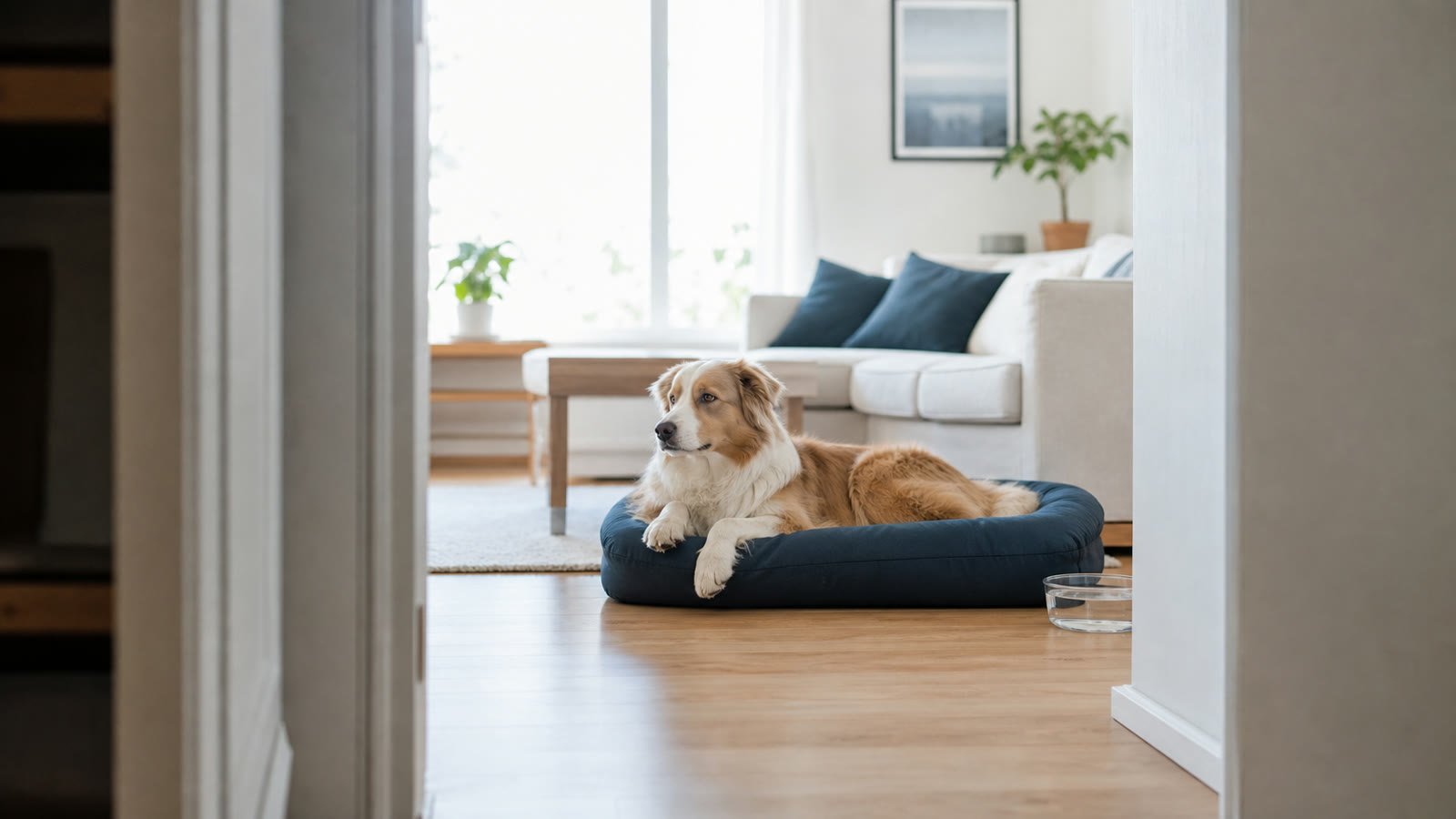
The question “how long can a dog be left alone?” has no single answer. Toilet needs, age, health, previous learning and emotional response all matter. A dog that remains quiet is not necessarily comfortable, and a puppy cannot manage the same absence as a settled healthy adult.
This guide provides a welfare-led framework for planning absences, teaching alone time gradually and recognising when a dog is not coping.
How long can a dog be left alone?
As a general welfare benchmark, the RSPCA advises no longer than four hours for an adult dog so it has opportunities for toileting, exercise and human contact. Many dogs need considerably less, including puppies, seniors, newly adopted dogs and dogs with medical or separation-related problems.
Why four hours is not a guarantee
The RSPCA advises that dogs generally should not be left alone for more than four hours, while stressing that the suitable duration depends on the individual. Four hours is an upper welfare guide, not a training target and not evidence that every dog will cope.
A comfortable duration is the period before the dog becomes worried, needs the toilet or has an unmet medical need. For one dog that may currently be minutes.
Factors that change safe alone time
- Age: puppies need frequent toileting, feeding and social support.
- Health: medication schedules, digestive problems, pain and urinary disease shorten the interval.
- History: newly adopted dogs need time to feel secure before absences expand.
- Training: comfortable solitude is learned progressively.
- Environment: temperature, noise and access to hazards affect safety.
- Previous distress: separation-related behaviours require an individual treatment plan.
Puppies, adult dogs and seniors
| Life stage | Main consideration | Planning approach |
|---|---|---|
| Puppy | Toileting, development and social learning | Very short practice with frequent human care |
| Healthy settled adult | Individual emotional and physical comfort | Build gradually; remain below the dog’s coping threshold |
| Senior | Mobility, cognition, medication and toileting | Shorter intervals and easier access to needs |
Do not use a simplistic “one hour per month of age” formula as a complete welfare plan. Toilet capacity does not equal emotional readiness.
How to teach a dog to stay alone
- Start while you are still at home by rewarding relaxation at a small distance.
- Practise neutral departure cues—picking up keys or putting on shoes—without always leaving.
- Step through a doorway for one or two seconds and return calmly.
- Use a camera to check posture and behaviour rather than relying on silence.
- Increase only when the dog remains loose, settled and able to engage with a safe activity.
- Vary durations so every practice does not become harder.
- Arrange human help for unavoidable absences beyond the dog’s current ability.
Signs the dog is not coping
- Panting, pacing, trembling or drooling unrelated to heat
- Continuous barking, whining or howling
- Scratching, chewing or throwing the body at doors and windows
- Refusing food that is normally valued
- Toileting despite otherwise reliable house training
- Frantic greeting combined with distress before departure
Do not wait for panic and assume the dog will “get used to it”. Repeated distress can sensitise the dog and make future absences harder.
Preparing the environment
Provide fresh water, a comfortable temperature, a safe resting area and a hazard-free space. Exercise and toileting before departure should be appropriate, not exhausting. Leave only enrichment already proven safe for that individual when unsupervised.
A crate is not a solution for long absences and can intensify panic in a dog attempting to escape. Confinement must be positively trained and appropriate for the individual.
Planning a working day
If travel and work exceed the dog’s comfortable limit, arrange a trusted family member, sitter or dog walker. Day care suits some social dogs but overwhelms others. Evaluate the provider, supervision, group matching and recovery after attendance.
Frequently asked questions
Can a dog be left alone for eight hours?
That exceeds the RSPCA’s four-hour general advice and leaves limited access to toileting, movement and company. Arrange reliable care during the day.
Can I leave a puppy alone while I work?
A young puppy needs frequent care and gradual training. Organise human support rather than expecting a full workday immediately.
Does another dog prevent separation anxiety?
Not necessarily. Anxiety may relate specifically to human absence, and adding another animal can create further welfare needs.
Should I leave the television on?
Familiar low-level sound may help some dogs, but it cannot treat distress or replace training and human care.
Should departures and greetings be calm?
Calm predictability can help, but severe separation distress is not caused simply by enthusiastic greetings.
When do I need professional help?
Seek veterinary and qualified behavioural support for panic, escape attempts, self-injury or an inability to tolerate even brief absence.
This guide offers general welfare information. Individual medical and behavioural needs take priority.